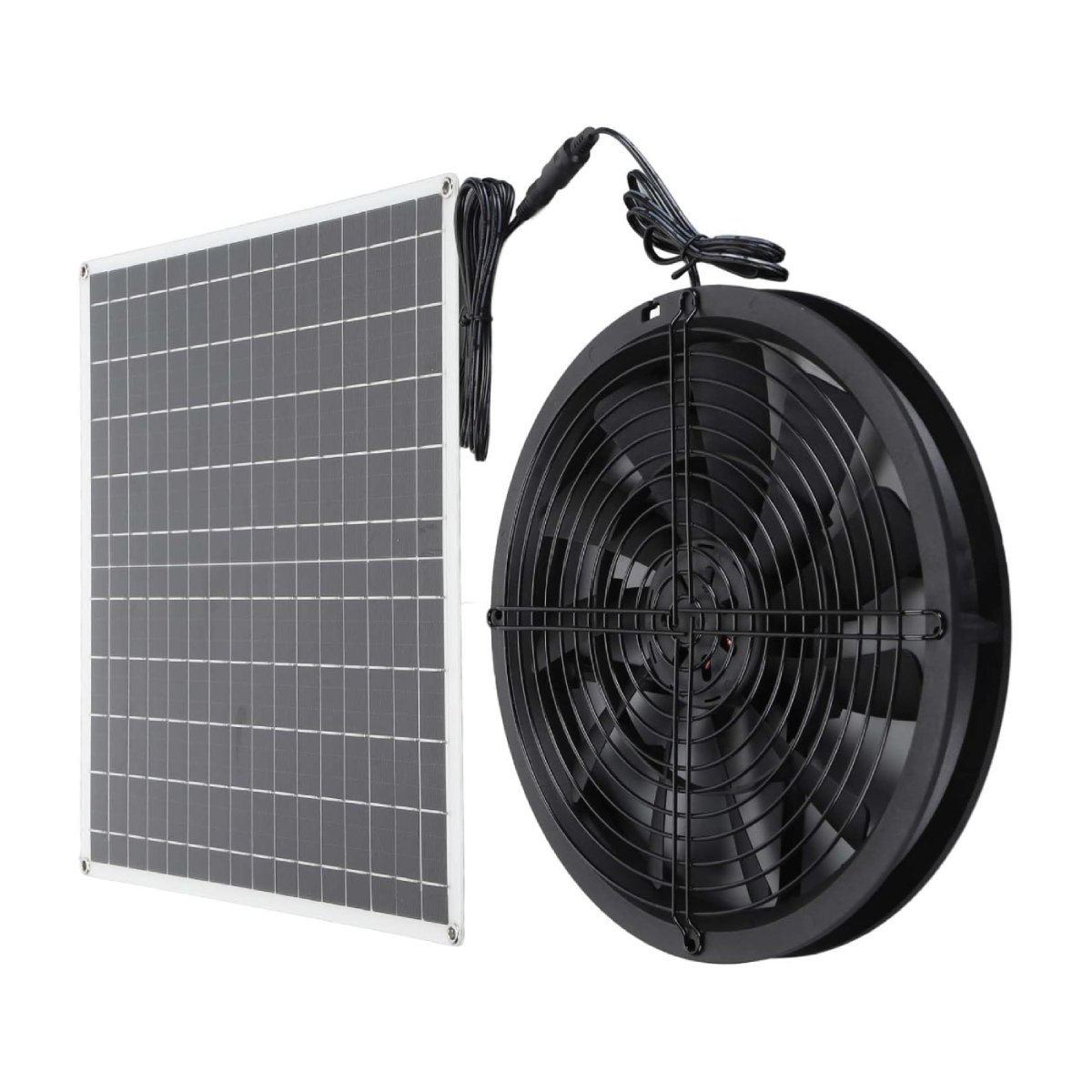
Solar fan for greenhouse
Greenhouse and agricultural solar fans help keep crops cool and maintain low humidity in off-grid locations where grid power is unavailable. SUNUW’s solar ventilation fans deliver consistent airflow through hoop houses, poultry sheds, and storage barns, operating entirely on monocrystalline solar panels. For farms and distributors, we offer bulk pricing, custom panel angles, and livestock-safe grille options.
The right fan size depends on greenhouse dimensions, climate, crop type, and ventilation requirements. For summer cooling, a common engineering guideline is approximately 8–10 CFM per square foot of greenhouse floor area. For example, a 1,000 sq.ft greenhouse may require a total airflow of 8,000–10,000 CFM. Multiple fans may be needed to meet the required capacity
The right fan size depends on greenhouse dimensions, climate, crop type, and ventilation requirements. For summer cooling, a common engineering guideline is approximately 8–10 CFM per square foot of greenhouse floor area. For example, a 1,000 sq.ft greenhouse may require a total airflow of 8,000–10,000 CFM. Multiple fans may be needed to meet the required capacity.
Yes. Solar greenhouse fans help remove trapped hot air and bring in fresh outdoor air, reducing heat buildup around plants. Their effectiveness depends on airflow capacity, intake openings, outdoor temperature, and solar conditions. Ventilation alone generally cannot cool a greenhouse below the outdoor air temperature; additional shading or evaporative cooling may be needed
Yes. Solar greenhouse fans help remove trapped hot air and bring in fresh outdoor air, reducing heat buildup around plants. Their effectiveness depends on airflow capacity, intake openings, outdoor temperature, and solar conditions. Ventilation alone generally cannot cool a greenhouse below the outdoor air temperature; additional shading or evaporative cooling may be needed.
For summer mechanical ventilation, many greenhouse design guidelines recommend approximately one complete air exchange per minute, equivalent to 60 air changes per hour (ACH). Lower ventilation rates may be suitable during cooler periods. The required airflow depends on greenhouse size, climate, crop requirements, and operating conditions
For summer mechanical ventilation, many greenhouse design guidelines recommend approximately one complete air exchange per minute, equivalent to 60 air changes per hour (ACH). Lower ventilation rates may be suitable during cooler periods. The required airflow depends on greenhouse size, climate, crop requirements, and operating conditions.
4. Can solar greenhouse fans operate at night or on cloudy days
Solar exhaust fans are commonly installed near one end of the greenhouse, with fresh-air intake vents positioned at the opposite end. This arrangement helps move air across the growing area and remove accumulated heat. Fan placement should consider greenhouse length, prevailing winds, inlet size, and mounting structure. Proper airflow design is essential for effective ventilation
Solar exhaust fans are commonly installed near one end of the greenhouse, with fresh-air intake vents positioned at the opposite end. This arrangement helps move air across the growing area and remove accumulated heat. Fan placement should consider greenhouse length, prevailing winds, inlet size, and mounting structure. Proper airflow design is essential for effective ventilation.
Yes. Solar ventilation fans can support air exchange in suitable barns, livestock shelters, poultry houses, storage sheds, and other agricultural buildings. However, ventilation requirements vary significantly by animal type, stocking density, moisture load, and climate. Critical livestock ventilation systems should include reliable backup power and appropriate environmental controls
Yes. Solar ventilation fans can support air exchange in suitable barns, livestock shelters, poultry houses, storage sheds, and other agricultural buildings. However, ventilation requirements vary significantly by animal type, stocking density, moisture load, and climate. Critical livestock ventilation systems should include reliable backup power and appropriate environmental controls,
Agricultural environments may expose fans to moisture, dust, fertilizer residue, and corrosive gases. Buyers should check motor protection, housing materials, corrosion resistance, electrical connections, and the applicable IP rating. Regular cleaning and inspection help maintain airflow performance. The appropriate protection level depends on the specific application and installation conditions
Agricultural environments may expose fans to moisture, dust, fertilizer residue, and corrosive gases. Buyers should check motor protection, housing materials, corrosion resistance, electrical connections, and the applicable IP rating. Regular cleaning and inspection help maintain airflow performance. The appropriate protection level depends on the specific application and installation conditions.
Yes. SUNUW supports OEM and ODM cooperation for agricultural equipment distributors, greenhouse builders, importers, and engineering contractors. Depending on the model and order requirements, customization may include solar panel configurations, motor specifications, mounting accessories, control options, branding, and packaging. Contact SUNUW for technical specifications, MOQ, sample availability, and bulk order quotations
Yes. SUNUW supports OEM and ODM cooperation for agricultural equipment distributors, greenhouse builders, importers, and engineering contractors. Depending on the model and order requirements, customization may include solar panel configurations, motor specifications, mounting accessories, control options, branding, and packaging. Contact SUNUW for technical specifications, MOQ, sample availability, and bulk order quotations.
Still have questions?
Request a product catalog, technical specifications, sample information, or an OEM/ODM quotation.

 william@sunuw.com
 +86 0574 8733 9116
 NO.10 Haitao Way, Yuyao, Ningbo, Zhejiang, China, 315000
Copyright © 2026 SUNUW All Rights Reserved. Designed & SEO by followala.cn Sitemap | XML